
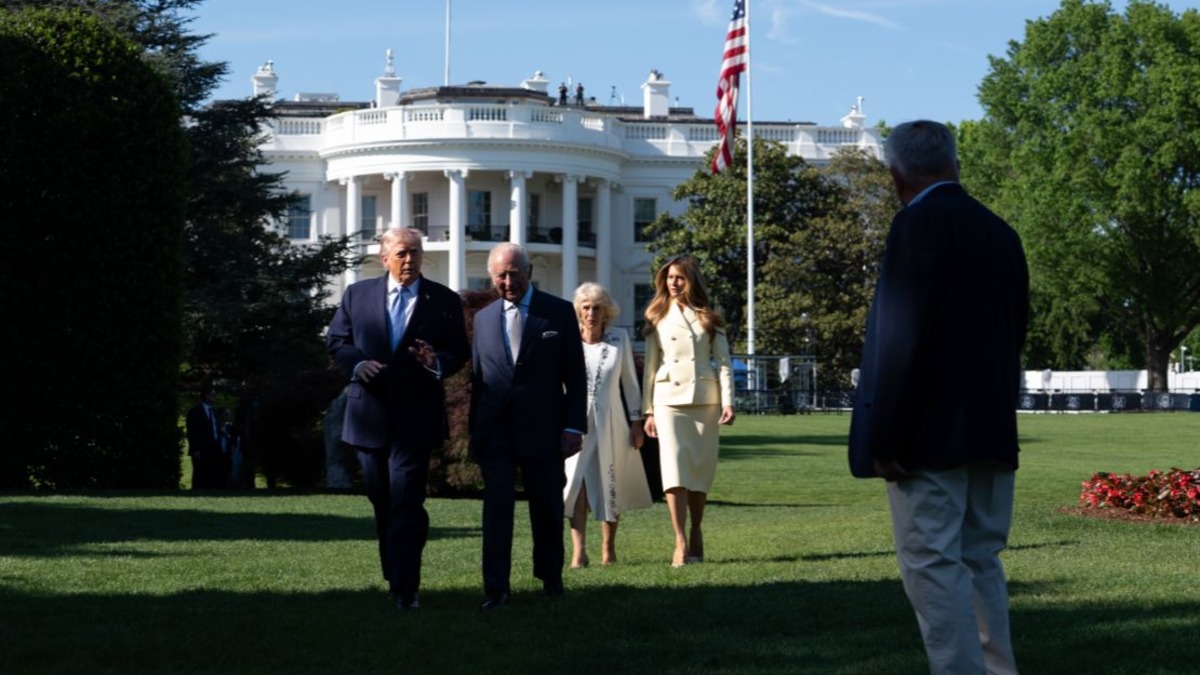
In diplomacy, tone is often substance by other means. When King Charles III arrived in the United States for a four-day state visit from April 27 to 30, 2026, the choreography was ceremonial, the symbolism unmistakable, and the subtext impossible to ignore. The visit coincided with the 250th anniversary of the United States, a moment designed to celebrate continuity. Yet beneath the pageantry lay a more urgent task: to steady a transatlantic relationship under visible strain.
The defining feature of the visit was not a single policy declaration or diplomatic breakthrough. It was something subtler, more difficult to quantify but no less consequential. It was the deployment of language as a strategic instrument. The oft-cited aphorism, frequently attributed to Winston Churchill, that diplomacy is the art of telling people to go to hell in such a way that they ask for directions, provides an unusually precise lens through which to interpret Charles’s performance. Whether Churchill actually coined the phrase is beside the point. The spirit of it hovered over every carefully crafted sentence the King delivered.
A visit framed by disagreement
The timing of the visit was anything but neutral. Transatlantic relations, long sustained by habit as much as shared interest, have entered a phase of recalibration. The immediate backdrop was the escalating U.S.-Israeli war with Iran, a conflict that has exposed deep divergences between Washington and its European allies.
At the center of the friction stood Donald Trump, whose second presidency has reintroduced a more transactional and unilateral approach to alliances. His public criticism of Keir Starmer over the United Kingdom’s reluctance to provide basing access for Iran-related operations was not merely rhetorical excess. It was a signal that Washington’s expectations of its closest partners have shifted.
For London, the dilemma is structural. The United Kingdom remains deeply embedded in the U.S.-led security architecture, yet it must also navigate domestic political constraints, European sensitivities, and a broader strategic environment where automatic alignment carries increasing costs. The result is a relationship that remains indispensable but no longer frictionless.
The tensions extend beyond the immediate crisis. Questions over NATO burden-sharing, diverging approaches to Ukraine, disagreements on climate policy, and the economic implications of energy disruptions linked to instability in the Strait of Hormuz all contribute to a more complex transatlantic equation. The “special relationship,” once defined by instinctive alignment, now requires active management.
The speech that said more than it said
It was against this backdrop that King Charles addressed a joint session of the U.S. Congress on April 28. The speech was, on its surface, a reaffirmation of shared values. He spoke of history, of sacrifice, of the enduring partnership between two nations bound by language, law, and memory. He emphasized that the relationship was “more important today than it has ever been,” a line that drew a standing ovation.
Yet the significance of the speech lay not in its affirmations, but in its calibrations.
Without naming policies or personalities, Charles invoked themes that carried unmistakable weight. He stressed the importance of alliances at a time when their credibility is under scrutiny. He highlighted the centrality of NATO, implicitly countering narratives that question its relevance. He spoke of stability in a “volatile world,” a phrase that resonated in the context of escalating conflict. He underscored the urgency of climate action, a subtle but clear contrast with Washington’s shifting priorities.
This was diplomacy by implication. The King did not challenge the United States. He reminded it of itself.
The language of “tough friendship”
The effectiveness of Charles’s approach lies in its duality. He positioned himself simultaneously as an ally and a mirror. His tone was neither admonishing nor deferential. It was something more nuanced: what might be described as “tough friendship.”
This is where the Churchillian aphorism becomes operational rather than decorative. To tell an ally that it is drifting, without triggering defensiveness, requires a specific kind of rhetorical discipline. It requires praise that is not flattery, criticism that is not accusation, and a structure of argument that allows the listener to arrive at the intended conclusion independently.
Charles’s speech achieved precisely that. By invoking shared history, he implicitly set a benchmark for present behavior. By emphasizing collective responsibility, he reframed unilateral actions as departures from a common tradition. By avoiding direct reference to contentious decisions, he preserved the dignity of his audience while still signaling concern.
The result was a message that could be heard without being resisted.
The monarchy as strategic instrument
In modern geopolitics, the British monarchy occupies a paradoxical position. It has no formal political authority, yet it retains significant diplomatic utility. Precisely because it operates above the day-to-day frictions of partisan politics, it can articulate positions that elected officials cannot express as freely.
King Charles’s visit demonstrated the continued relevance of this role. At a moment when political leaders on both sides of the Atlantic are constrained by domestic considerations, the monarch can function as a stabilizing voice. His legitimacy derives not from electoral mandate but from continuity, from the perception that he represents something enduring in a rapidly shifting landscape.
This is not merely symbolic. In periods of tension, symbolism can shape perception, and perception can influence policy space. By reaffirming the depth of the U.S.-UK relationship while gently highlighting its strains, Charles created room for recalibration without escalation.
Strategic timing and controlled visibility
The visit’s timing amplified its impact. Coming in the immediate aftermath of heightened tensions over Iran and amid broader debates about the future of NATO, it served as a form of high-visibility reassurance. It signaled that, despite disagreements, the relationship remains intact.
At the same time, it avoided the trap of appearing as a corrective intervention. There was no attempt to mediate specific disputes or propose concrete policy solutions. The objective was more limited but arguably more realistic: to preserve the framework within which those disputes can be managed.
This reflects a broader shift in diplomatic practice. In an era where structural disagreements are harder to resolve, the emphasis often shifts from resolution to containment. The goal is not to eliminate differences, but to prevent them from becoming unmanageable.
Echoes of history, without nostalgia
Historical analogies inevitably accompany discussions of transatlantic relations. The Suez Crisis of 1956, the divisions over the Iraq War in 2003, and earlier moments of divergence are frequently invoked as precedents. Yet the current phase differs in important respects.
The earlier crises occurred within a more stable strategic framework. The Cold War, despite its tensions, provided a clear organizing principle. Today’s environment is more fragmented. The rise of China, the persistence of Russian assertiveness, instability in the Middle East, and the growing importance of non-traditional security issues such as climate change all contribute to a more diffuse set of challenges.
In this context, King Charles’s references to history were carefully calibrated. They were not nostalgic invocations of past unity, but reminders of a tradition of cooperation that must be actively sustained.
Economic undercurrents
The geopolitical tensions surrounding the visit have tangible economic dimensions. The conflict involving Iran has already affected global energy markets, with disruptions in the Strait of Hormuz translating into higher costs, particularly for European economies.
For the United Kingdom and the European Union, the stakes are immediate. Energy security, inflationary pressures, and broader economic stability are directly linked to developments in the Middle East. The United States, while less directly exposed, remains a central actor in shaping the trajectory of the crisis.
In this context, Charles’s emphasis on stability and cooperation can also be read as an indirect appeal for de-escalation. Again, the message was not explicit, but the implications were clear.
NATO and the question of reliability
No discussion of transatlantic relations can avoid the question of NATO. The alliance remains the cornerstone of Western security, yet its future direction is increasingly contested.
The United Kingdom has been among the more consistent advocates of maintaining strong commitments, including higher defense spending targets. The United States, under Trump’s leadership, has placed greater emphasis on burden-sharing and has occasionally signaled a more conditional approach to alliance obligations.
King Charles’s references to NATO were therefore significant. By highlighting its importance without entering into the specifics of current debates, he reinforced the principle of collective security while avoiding entanglement in policy disputes.
Reception and interpretation
The reception of the visit reflected its carefully balanced nature. In the United Kingdom, it was widely interpreted as a demonstration of diplomatic skill, with emphasis on the subtlety of the King’s messaging. In the United States, the focus was more on the ceremonial aspects and the reaffirmation of the relationship.
Notably, there was no overt backlash from the White House. This, in itself, is indicative of the success of the approach. A more direct critique might have triggered a defensive response, undermining the visit’s objectives. By contrast, the indirect method allowed the message to be delivered without provoking confrontation.
The limits of symbolism
It would be a mistake, however, to overstate the immediate impact of the visit. Symbolic diplomacy can shape atmospherics, but it cannot resolve structural disagreements. The underlying issues that have strained transatlantic relations remain in place.
The divergence over Iran policy, the debates over NATO’s future, differences in economic priorities, and broader questions about the direction of U.S. foreign policy are unlikely to be resolved through rhetorical finesse alone.
What the visit achieved was more modest, but still important. It helped prevent those disagreements from defining the relationship entirely. It reaffirmed the existence of a shared framework, even as the content of that framework is contested.
A map, not a mandate
In the end, King Charles III’s visit to the United States was less about delivering instructions than about providing orientation. It did not tell Washington what to do. It suggested how it might think about what it is doing.
This is the essence of the diplomatic art captured in the Churchillian aphorism. The objective is not to compel, but to guide. Not to confront, but to influence. Not to close doors, but to ensure that they remain open.
At a time when transatlantic relations are undergoing a period of adjustment, such an approach has particular value. It recognizes the limits of influence while still seeking to exercise it. It accepts the reality of disagreement while working to prevent its escalation.
In a world increasingly defined by blunt instruments and direct confrontation, the subtlety of Charles’s diplomacy stands out. It is a reminder that, even in an era of strategic competition and political volatility, there remains a place for language that persuades without provoking, that challenges without alienating, and that, in the most understated way possible, shows the path forward.
For subscriptions: https://ankahaber.net/RequestSubscription